 Homes Trak™
How To Keep Track Of Appliance Warranties (And Never Miss One)
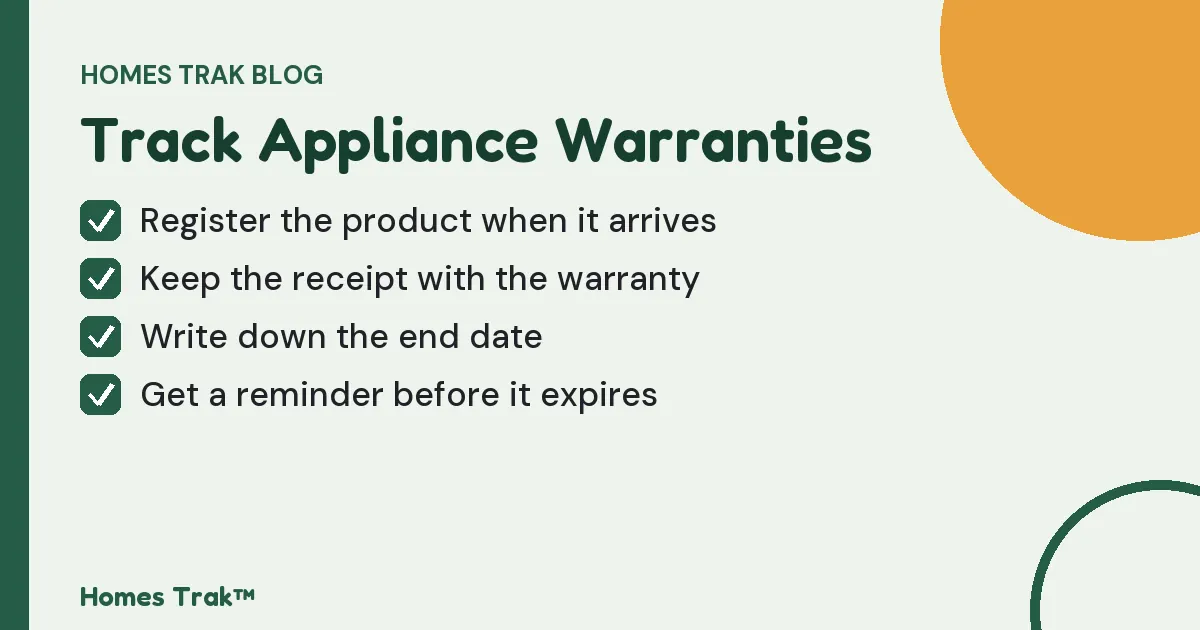
A dishwasher stops draining at month eleven. You know it came with a one-year warranty, but where is the receipt? Was it bought in March or May? Did anyone register it? By the time you find the answers, the window may have closed.
Warranties only help if you can prove what you bought, when you bought it, and that the coverage is still active. That takes a few minutes of setup per appliance and a reminder you can trust. This guide gives you a simple system that works for one new microwave or a whole kitchen.
What a warranty actually needs from you
The Federal Trade Commission explains that a warranty is a promise from the manufacturer or seller to stand behind the product. To use it, you usually need three things.
- Proof of purchase. The FTC advises keeping the sales receipt with the warranty, because it shows the purchase date and that you are the original owner.
- The terms. These say what is covered, for how long, and what you must do to file a claim.
- Registration, sometimes. The FTC notes that some companies require you to send a registration card to qualify for warranty service. Others use registration only for marketing or recalls. Read the terms to see which applies.
Beyond the written warranty, state law often gives you implied warranties. The FTC says these can last up to four years in some states. The details vary by state, so check your state's consumer protection office if a problem comes up after the written warranty ends.
Steps
- Open the box and find the warranty card or booklet before you throw away the packaging.
- Register the product with the manufacturer if the terms require it or if you want recall notices. Most brands offer online registration.
- Photograph the rating plate or label that shows the model and serial number. The serial is often on the back, inside the door, or on the bottom.
- Scan or photograph the receipt the same day. Paper receipts from some printers fade over time.
- Write down the purchase date, the store, the price and the warranty length.
- Work out the end date and record it. A one-year warranty bought on April 10 ends around April 10 of the next year, but read the terms for the exact start.
- Set a reminder about a month before the end date, so you have time to test the appliance and file a claim.
- Keep everything for one appliance together, in one folder or one record.
Where to keep it all
The best system is the one you will actually open again. Here are three common choices.
A paper folder
A single accordion folder with a tab per appliance works well for many homes. It is easy to start, and the receipts stay in one place. The weak spot is the end date. Paper does not remind you of anything, so you still need a calendar entry.
A spreadsheet plus a photo folder
A spreadsheet can hold the appliance, model, serial, purchase date, end date and a link to the scanned receipt. It is searchable and you can sort by end date. It needs discipline, though. If you forget to add a row, the system has a hole you will not notice until you need it.
A home record app
An app built for home records can hold the photos, dates and documents in one place and send the reminder for you. Homes Trak, an app for iPhone and iPad, stores each warranty with its end date and reminds you 30 days before it ends. Its nameplate scan fills in an appliance's brand, model and serial from a photo of the label, and the document vault can scan paper receipts and manuals to PDF. You can see the details on the features page.
What to record for each appliance
Whatever tool you choose, the same fields matter:
- Appliance and room, such as "Refrigerator, kitchen"
- Brand, model and serial number
- Purchase date and store
- Price paid
- Warranty length and end date
- Any extended warranty or service contract, with its own end date and phone number
- Installer, if one was used
- Where the manual is
That last item saves time when something breaks. Many problems have a simple fix listed in the troubleshooting section of the manual.
Extended warranties and service contracts
Stores often offer extra coverage at checkout. The FTC points out that these service contracts cost extra and may overlap with coverage you already have from the manufacturer. Before buying one, compare its start date and terms with the written warranty. If you do buy one, record it as a separate item with its own end date and claim number, since it often has different rules.
Make it a habit
Two small habits keep the system working:
- Add new purchases the same week. It takes a few minutes while the box is still on the floor.
- Review once a year. Look for warranties ending in the next few months and test those appliances while they are still covered.
If you are setting up records for a whole house at once, start with the big systems and the newest appliances, since those are the ones most likely to still be under warranty. Our guide on what documents to keep after buying a house covers the rest of the paperwork, and the guide to doing a home inventory for insurance shows how to record everything else you own.
Frequently asked questions
Do I have to register an appliance to keep the warranty?
It depends on the company. The FTC says some warranties require a registration card to qualify for service, while others do not. Read the warranty terms. Registering is often still useful because it helps the maker reach you about recalls.
What if I lost the receipt?
Check your email for an online order confirmation, and look at your card or bank statement for the purchase. Some stores can look up a purchase with the card you used. Keep whatever proof you can find with the warranty from now on.
When does an appliance warranty start?
Most start on the purchase date or the delivery date, and some start at installation. The terms say which. That is why keeping the receipt and any delivery or install invoice together matters.
Is an extended warranty worth it?
That depends on the product, the price and the coverage you already have. The FTC notes that service contracts cost extra and can overlap with the manufacturer's warranty. Compare the terms before deciding, and record any contract you buy with its own end date.