 Homes Trak™
How Often To Flush A Water Heater, Tank Or Tankless
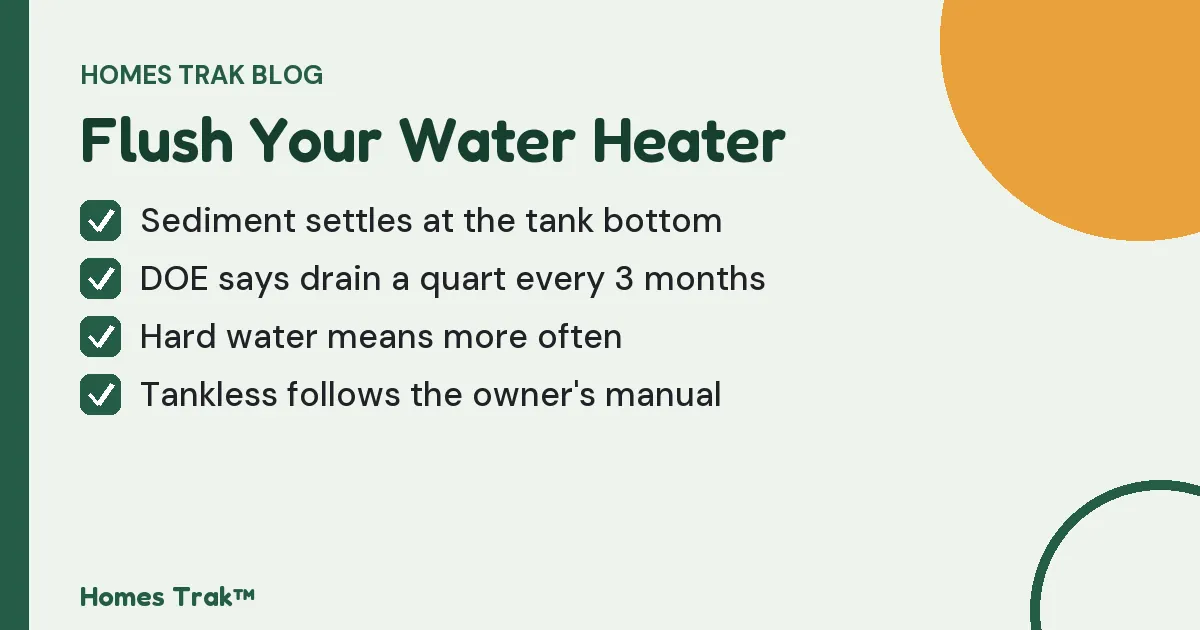
Minerals in tap water settle to the bottom of a tank water heater over time. That layer of sediment sits between the burner or heating element and the water, so the heater has to work harder to do the same job. You may hear rumbling or popping, and you may notice the hot water running out sooner.
Flushing removes that sediment. The question most people ask is how often. The answer depends on the type of heater and your water. This guide covers tank and tankless units and explains how to make the job a habit.
How sediment affects a tank water heater
Montana State University Extension explains that sediment buildup reduces a water heater's efficiency and its capacity. The U.S. Department of Energy says sediment impedes heat transfer and lowers efficiency.
In plain terms, a tank full of sediment holds less hot water and uses more energy to heat it. Over years, heavy buildup can also make the tank noisy.
How often to flush a tank water heater
Two reputable sources give practical intervals.
- The Department of Energy suggests draining a quart of water from the tank every three months to remove sediment. Its Energy Saver Guide presents this as a simple efficiency tip.
- Montana State University Extension says that in some areas, depending on how hard the water is, monthly flushing is recommended, while in others the tank needs flushing only once a year.
So there is a range, and your water decides where you fall in it. A short drain every few months keeps sediment from building up. A fuller flush, where you drain until the water runs clear, can be done less often, on a schedule that fits your water.
Your water heater's manual has the final word. Follow the manufacturer's instructions for your model, since some have specific steps or warnings.
What hard water changes
Hard water carries more dissolved minerals, so it leaves more sediment behind. If you see white scale on faucets and shower heads, or your utility reports hard water, plan to drain more often. Many water utilities publish a water quality report each year that lists hardness.
A water softener reduces the minerals that cause scale. If you have one, your tank may build sediment more slowly. Keep checking anyway, because the only way to know is to look at what comes out of the drain valve.
A simple drain routine for tank heaters
This is general guidance based on Montana State University Extension. Read your manual first, and call a plumber if anything is unclear or the valve is hard to operate.
- Find the drain valve near the bottom of the tank.
- For safety, turn the heater down or off according to the manual. For an electric heater, MSU Extension says to turn the power off at the breaker before opening any thermostat panels.
- Place a bucket under the valve, or attach a garden hose and run it to a drain. MSU Extension suggests using a hose the first time if the valve has not been opened in years, in case it is hard to shut off.
- Open the valve and let the murky water drain until it runs clear. MSU Extension says this usually takes one to two gallons.
- Close the valve firmly and check that it does not drip.
- Restore power or gas according to the manual.
Be careful. The water coming out can be very hot. Keep children and pets away, and wear gloves.
While you are there, MSU Extension also recommends checking the temperature and pressure relief valve once a year to make sure it works. If you are not comfortable doing that, ask a plumber to check it at a service visit.
How tankless water heaters are different
A tankless water heater does not store water, so sediment does not settle in a tank. Minerals can still build up as scale inside the heat exchanger, especially with hard water. That is why tankless units are usually descaled, often by circulating a cleaning solution through the unit with a small pump.
There is no single interval that fits every tankless model. Follow the owner's manual for your unit, which gives the maker's schedule and method. Some models show a maintenance code on the display when it is time. If your water is hard, expect to descale more often than a home with soft water. If the manual calls for a professional, or you are not sure how to isolate the unit, hire a licensed plumber.
Signs your water heater needs attention
Flushing on a schedule is the goal, but watch for these signs between visits:
- Rumbling, popping or crackling noises from the tank
- Hot water running out faster than it used to
- Rusty or cloudy hot water
- Water pooling around the base of the tank
- A relief valve that drips or leaks
Leaks and rust around the base can point to a tank near the end of its life. Our guide on how to tell how old your water heater is shows how to read the age from the label.
Keeping it on a schedule
A three-month or yearly task is easy to forget, because nothing reminds you until the tank gets noisy. A reminder fixes that.
Homes Trak, an app for iPhone and iPad, builds a maintenance calendar from the systems in your home and sends a phone alert when a task is due. You can add the water heater with its install year, see expected life left, and log each flush so you can see the history later. The features page shows how it works.
For a broader routine, see the guide to the best way to keep track of home maintenance.
Frequently asked questions
How often should I flush my tank water heater?
The Department of Energy suggests draining a quart of water every three months to remove sediment. Montana State University Extension notes that, depending on water hardness, some areas call for monthly flushing and others only yearly. Follow your manufacturer's instructions for your model.
How often should I flush a tankless water heater?
Follow the owner's manual for your unit, since makers set their own schedule and method. Hard water leads to scale faster, so homes with hard water usually need to descale more often. A licensed plumber can do it if you prefer.
What happens if I never flush my water heater?
Sediment builds up at the bottom of the tank. MSU Extension says this reduces efficiency and capacity. The heater uses more energy, may hold less hot water, and can become noisy.
Is it safe to flush a water heater myself?
You can usually drain a little water safely by following the manual. The water can be very hot, so wear gloves and keep others away. For an electric heater, turn the power off at the breaker first. If the valve is stuck or leaks, call a plumber.
Sources
- U.S. Department of Energy, Energy Saver Guide (2022)
- Montana State University Extension, Water Heater Maintenance