 Homes Trak™
How to Check for a Water Leak in Your House
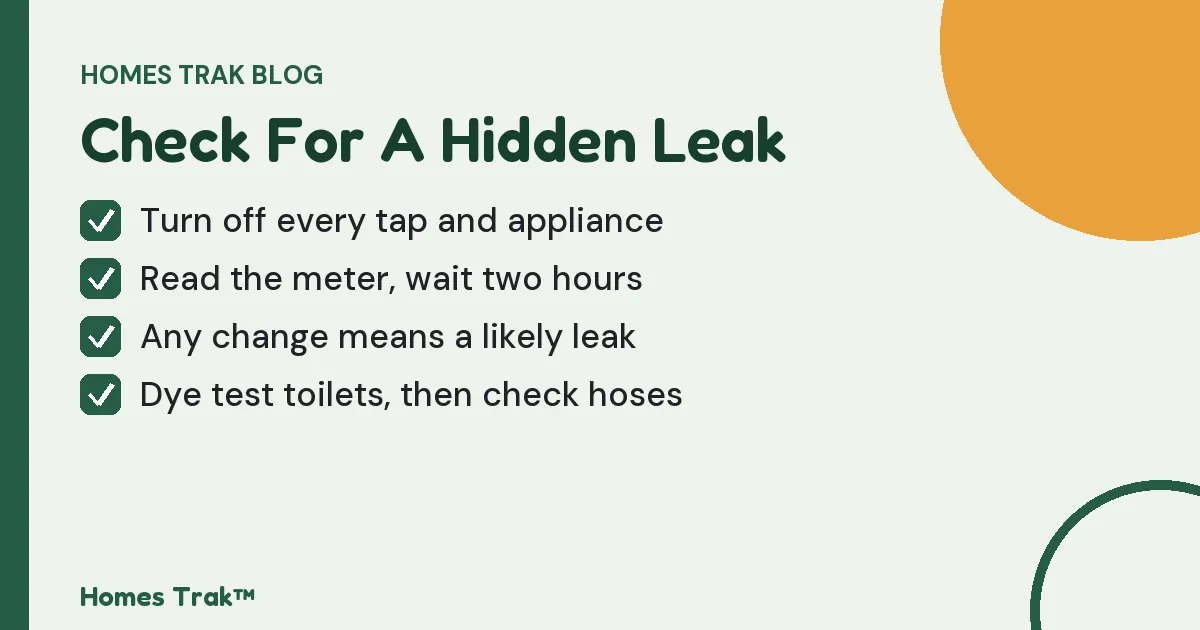
To check for a water leak, turn off every faucet and water appliance, write down the reading on your water meter, and read it again two hours later without using any water. If the number changed, you very likely have a leak somewhere on your side of the meter.
This is the test the EPA WaterSense program suggests, and it costs nothing. Below are the steps, how to read the meter, and how to track down the leak once you know it is there.
Why hidden leaks are worth hunting
A slow leak can run for months before it shows. Water seeps into a subfloor, a wall cavity or the slab, and by the time you see a stain or smell mildew, the damage is done. The EPA says household leaks waste nearly 1 trillion gallons of water a year across the United States.
The early clues are easy to miss.
- A water bill that is higher than the same month last year
- A toilet that runs or refills on its own
- The sound of water when nothing is on
- Warm spots on a floor, which can point to a hot water line leak
- Musty smells, bubbling paint or soft drywall
If you notice any of these, run the meter test today.
Find and read your water meter
Most meters sit in a box near the street, at the edge of the yard or sidewalk, under a metal or plastic lid. In cold climates the meter is often inside, in the basement or a utility room where the main line comes in. If you cannot find it, call your water utility.
Open the lid carefully, since insects and spiders like meter boxes. You will see a number display that works like a car's odometer, plus a sweep hand. Many meters also have a small leak indicator, often a red or blue triangle or star, that spins when any water flows through. If it spins with everything off, water is moving.
Steps
- Turn off every faucet, shower and water appliance in the house, including the washer, dishwasher, ice maker and sprinklers.
- Make sure nobody will use water for the next two hours.
- Write down the full number on the meter, or take a clear photo of it.
- Wait two hours.
- Read the meter again. If the number went up, water left the pipes somewhere, and you likely have a leak.
- To narrow it down, find your main shut off valve inside the house and close it. Read the meter again after a while. If the meter still moves with the house valve closed, the leak may be in the line between the meter and the house. If it stops, the leak is inside.
If you do not know where the inside shut off is, see where is my water shut off valve. Find it before you need it in an emergency.
Where leaks usually hide
Once the meter tells you a leak exists, check the most common spots first.
Toilets
Toilets are a top source of silent leaks. A worn flapper lets water trickle from the tank into the bowl all day. The EPA suggests a dye test. Put a few drops of food coloring in the tank, wait 10 minutes without flushing, and look in the bowl. If color shows up, the flapper is leaking. Flush right after the test so the dye does not stain.
Faucets and showerheads
A drip is easy to hear at night. Check every faucet, the tub spout and the showerhead. Worn washers and cartridges are cheap to replace.
Supply lines and hoses
Look under every sink and behind the toilet at the flexible supply lines. Then check the washing machine hoses, the dishwasher line and the fridge water line. Look for drips, rust, bulges or a damp floor. Washer hoses are a common source of floods. See how often to replace washing machine hoses.
Water heater
Look for water around the base, a dripping relief valve pipe or rust on the tank. A tank that leaks from the bottom usually needs to be replaced. Our guide on how to tell how old your water heater is helps you decide if it is near the end.
Outside
Check hose bibs, sprinkler lines and the ground between the meter and the house. A patch of grass that stays green and soft in dry weather can mean a leak in the service line.
When to call a plumber
Call a licensed plumber if the meter shows a leak and you cannot find it, if the leak is inside a wall or under a slab, or if the service line may be leaking. Plumbers have tools to listen for leaks and to test pressure. Your water utility may also help find leaks on its side of the meter.
Check with your insurance agent about water damage coverage. Policies differ on sudden leaks and slow leaks, so ask before a problem happens.
Make it a habit
A meter test takes two hours of waiting and two minutes of work. Doing it a few times a year, and after any unusual bill, catches leaks while they are small. Saving each reading with a date lets you spot a change over time.
How Homes Trak helps
Homes Trak, an app for iPhone and iPad, keeps utility readings with meter photos, so you can compare one reading to the next. You can add your own reminder for a meter test or a hose check at any interval. The Emergency section stores shut off photos, a breaker map and emergency contacts, and makes an Emergency Sheet you can print. See the features page. Homes Trak is Coming Soon to the App Store and Google Play.
Frequently asked questions
How long should I wait during a water meter leak test?
The EPA WaterSense program suggests two hours with no water use. A longer wait, such as overnight, can catch very slow leaks. Make sure no appliance runs during the test.
What does the triangle on my water meter mean?
On many meters the small triangle or star is a leak indicator. It turns when any water flows through the meter. If it spins with every faucet and appliance off, water is moving somewhere.
How do I know if my toilet is leaking?
Put a few drops of food coloring in the tank and wait 10 minutes without flushing. If color appears in the bowl, the flapper is likely letting water through and should be replaced.
Who pays for a leak between the meter and the house?
In many areas the homeowner is responsible for the line from the meter to the house, and the utility handles the meter and the street side. Rules vary, so ask your water utility.