 Homes Trak™
Home Maintenance Checklist for New Homeowners
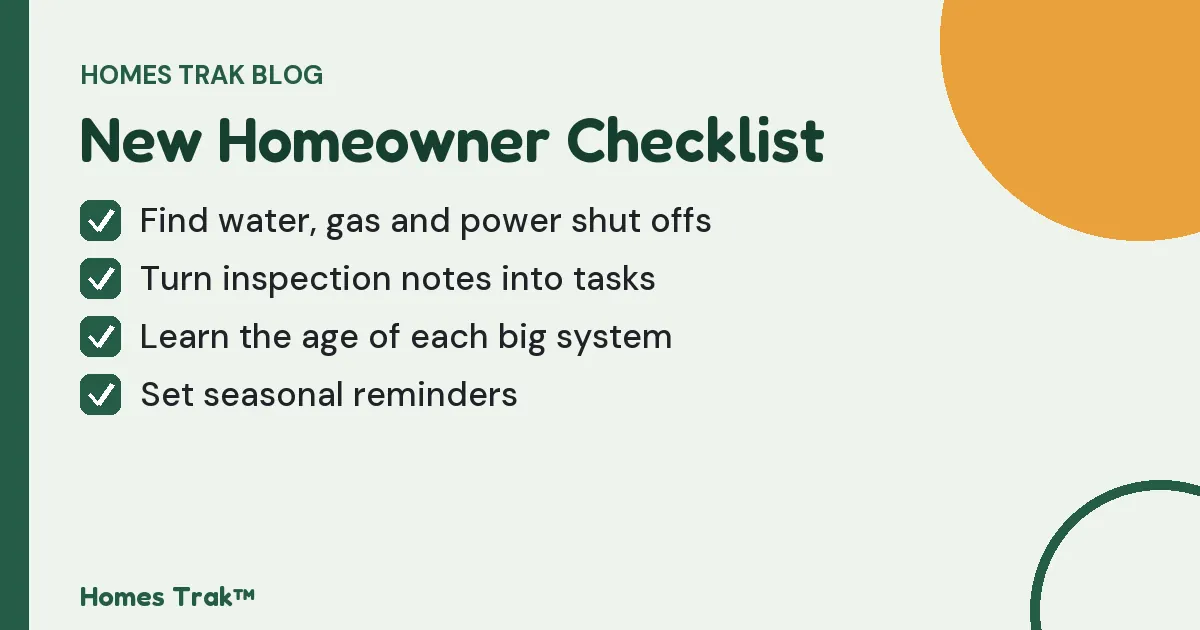
In your first week as a new homeowner, find the water, gas and electrical shut offs, change the locks, and test the smoke and carbon monoxide alarms. In your first month, turn the home inspection report into a repair list and learn the age of each big system, then set up a seasonal maintenance routine for the first year.
Buying the house was the hard part. Keeping it in good shape is mostly about knowing what you have and doing small jobs on time. This checklist splits the work into three stages so it does not feel like a hundred things at once.
First week
These tasks are about safety and control of the house.
- Find the main water shut off and test that it turns. See where is my water shut off valve.
- Find the gas meter and its shut off. Only turn off gas in an emergency, and let the gas company turn it back on.
- Find the electrical panel and check that the breakers are labeled. If they are not, label them one at a time.
- Change or rekey the locks. You do not know how many keys the past owners handed out.
- Test every smoke alarm and carbon monoxide alarm. Replace batteries, and replace any alarm past its expiration date printed on the back.
- Find the fire extinguisher, or buy one for the kitchen.
- Save the phone numbers for your water, power and gas companies and a plumber you can call at night.
Take a photo of each shut off. In a leak or a gas smell, nobody wants to search for a valve in the dark.
First month
Now get organized and learn what you bought.
Turn the inspection report into a task list
The home inspection report is the best map of your house you will ever get. Go through it page by page. Write each finding as a task, from a loose railing to a missing GFCI outlet. Sort them into three groups.
- Safety items to fix right away
- Repairs to schedule in the next few months
- Things to watch over time
Learn the age of each big system
Write down the install year for the roof, furnace or heat pump, air conditioner, water heater and electrical panel. If you have a septic system or a well, add those too. The inspection report and seller disclosure are good places to start. Our guides on how to find out how old your roof is and how to find the age of an HVAC unit show where to look for dates.
Compare each age to a typical life span using the InterNACHI life expectancy chart. A system near the end of its life goes to the top of your savings plan.
File your papers
Keep the deed, closing disclosure, title policy, survey, inspection report and warranties together. The CFPB's guide on what to do after closing explains which closing papers to keep. Our list of what documents to keep after buying a house covers the rest.
Make a home inventory
Walk each room with your phone and record what you own. It takes an hour or two now and saves days after a fire or break in. See home inventory for insurance room by room.
First year
The first year teaches you how the house behaves in every season. Set a routine and stick to it.
Steps
- Check the HVAC air filter monthly and change it when it is dirty. The Energy Star maintenance checklist suggests checking it every month and changing it at least every three months.
- Book a heating tune up in the fall and a cooling tune up in the spring.
- Clean the gutters in late spring and late fall, more often under big trees.
- Test smoke and carbon monoxide alarms every month.
- Clean the dryer vent at least once a year. See how often to clean a dryer vent.
- Flush the water heater on the schedule in its manual. See how often to flush a water heater.
- Check washer hoses, toilets and sink supply lines for drips twice a year.
- Walk the outside of the house each season. Look at the roof, siding, foundation, grading and caulk around windows.
- Shut off and drain outdoor faucets before the first freeze if you live in a cold climate.
Add tasks for your climate. Homes in hurricane areas need storm prep. Homes in wildfire areas need brush cleared away from the house. Homes in termite areas need regular checks.
Keep a record of everything
Every time you fix, service or replace something, write it down with the date, the cost and who did the work. Save the receipt. A good record helps you spot patterns, makes warranty claims easier, and gives a buyer confidence when you sell.
Keep upkeep and improvements apart. A new water heater is a replacement. A finished basement is an improvement. Improvement records can matter for taxes when you sell, as the IRS explains in Publication 523.
Budget for the first year
New owners are often surprised by how much small repairs add up. Set aside money for routine upkeep and for the big systems that are getting old. Our guide on how much to budget for home maintenance shows a simple way to build that number.
How Homes Trak helps
Homes Trak, an app for iPhone and iPad, has a Move In checklist that turns inspection findings into tasks. It sends maintenance reminders based on your home profile and climate zone, with Reminder Packs for hurricane, freeze and pipes, wildfire, flood and sump, salt air, termite, and deck and fence. You can change any interval or add your own. The Emergency section keeps shut off photos and a breaker map, and the Vault holds closing papers. See the features page. Homes Trak is Coming Soon to the App Store and Google Play.
Frequently asked questions
What should I do first after buying a house?
Find the water, gas and electrical shut offs, change the locks, and test smoke and carbon monoxide alarms. These protect the house and the people in it before anything else.
How do I use my home inspection report after closing?
Turn each finding into a task and sort the list into safety items, near term repairs and things to watch. Work through the safety items first.
How often should a new homeowner do maintenance?
Some tasks are monthly, like checking the air filter and testing alarms. Others are seasonal, like gutters and HVAC tune ups. A few are yearly, like cleaning the dryer vent.
Do I need a home warranty as a new homeowner?
It depends on the age of the systems, your savings and the contract terms. Read what a plan covers and excludes before you buy one, and compare it to setting money aside yourself.
Sources
- Energy Star, Maintenance checklist
- InterNACHI, Standard estimated life expectancy chart for homes
- CFPB, After closing on a home
- IRS, Publication 523, Selling your home